

I sat down with a Florida mortgage professional, Peter Kilsheimer, expecting to learn more about reverse mortgages. Instead, I walked away with a completely different perspective on retirement, home equity, and why paying cash for a house isn't always the obvious answer.
For decades, we have been sold one version of retirement success: pay off the house, eliminate debt, and hold the deed free and clear until the end.
It sounds perfect. You sell a high-cost home in California, New York, New Jersey, Minnesota, or somewhere else, move to Central Florida, buy a beautiful new place in cash, and never write another mortgage check.
Peter asked a question I had never really considered before: what happens when all of your wealth becomes trapped inside your home?
That is where the conversation around reverse mortgages gets interesting. Not the late-night-TV version built around fear and desperation. The real question is whether home equity can be used strategically to protect liquidity, support retirement cash flow, manage taxes, and help you enjoy the life you spent decades building.
The Retirement Relocation Dilemma
Florida continues to draw retirees and relocating homeowners in enormous numbers. If you have spent years paying down a home in a high-cost market, you may arrive here with substantial equity.
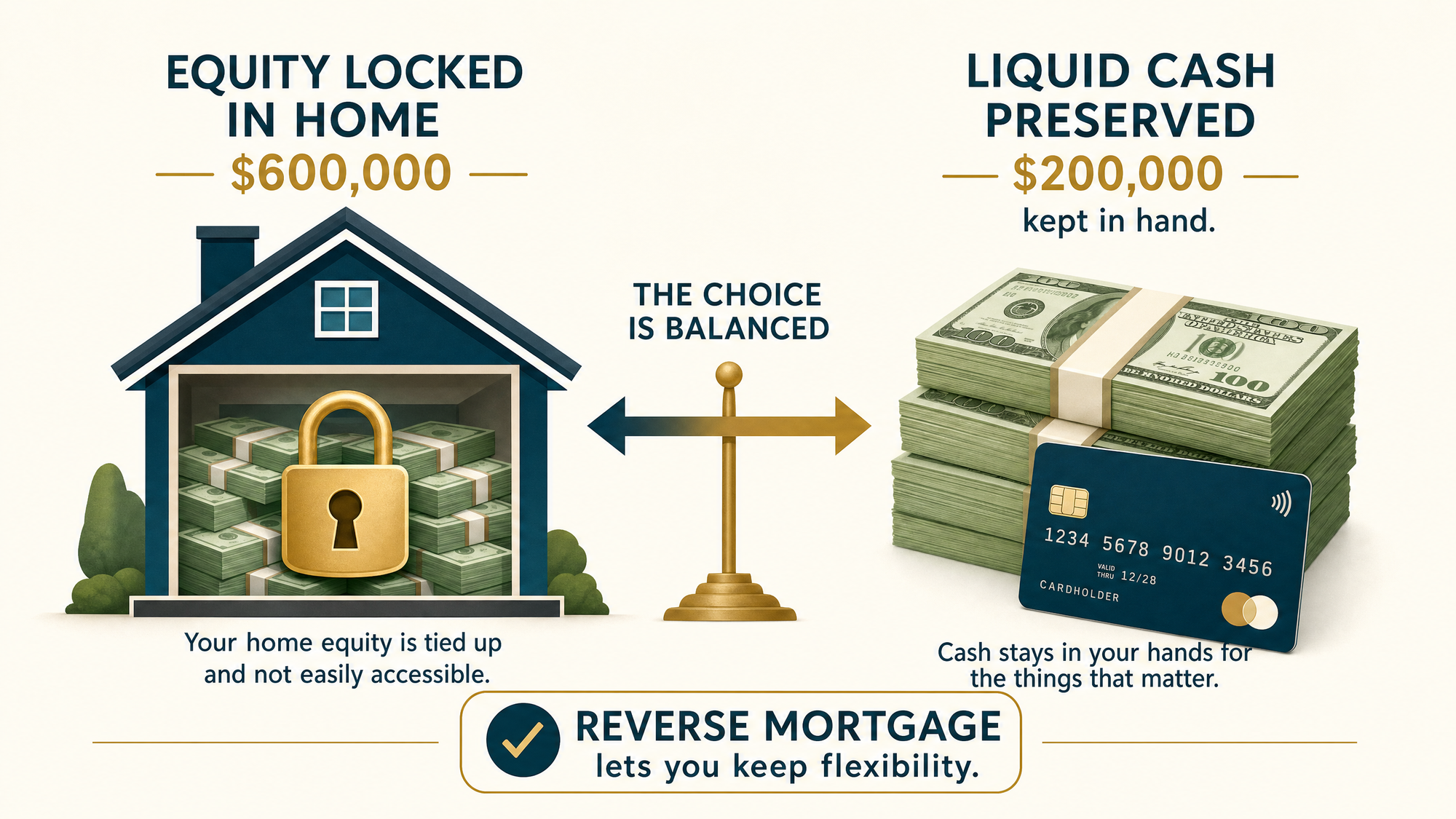
Consider a simple example. You sell your longtime home and walk away with $800,000 after closing costs. Then you find a newly built Central Florida home for $600,000.
The conventional move is clear: write the $600,000 check, own the home outright, and keep the remaining $200,000 in the bank.
There is nothing inherently wrong with that. But it may create a liquidity problem.
By paying cash, you have converted a large liquid asset into an illiquid one. You still have wealth, but much of it is now trapped in drywall, concrete, and land. On paper, you may be very well off. In day-to-day life, you may feel much less financially flexible.
That lack of flexibility can change how retirement feels. You may hesitate before:
- Taking the grandkids on a meaningful vacation
- Helping family through an unexpected need
- Investing in a business opportunity
- Handling a major medical expense or home repair
- Making the lifestyle upgrades you moved to Florida to enjoy
It is possible to be house-rich while becoming cash-constrained. Wealth matters most when you can deploy it when it is actually needed.
Before deciding how much cash to put into a Florida home, it is worth reviewing the broader financing options in an Orlando home buying guide focused on down payments and mortgage mistakes.

Why a Reverse Mortgage Changes the Cash Flow Equation
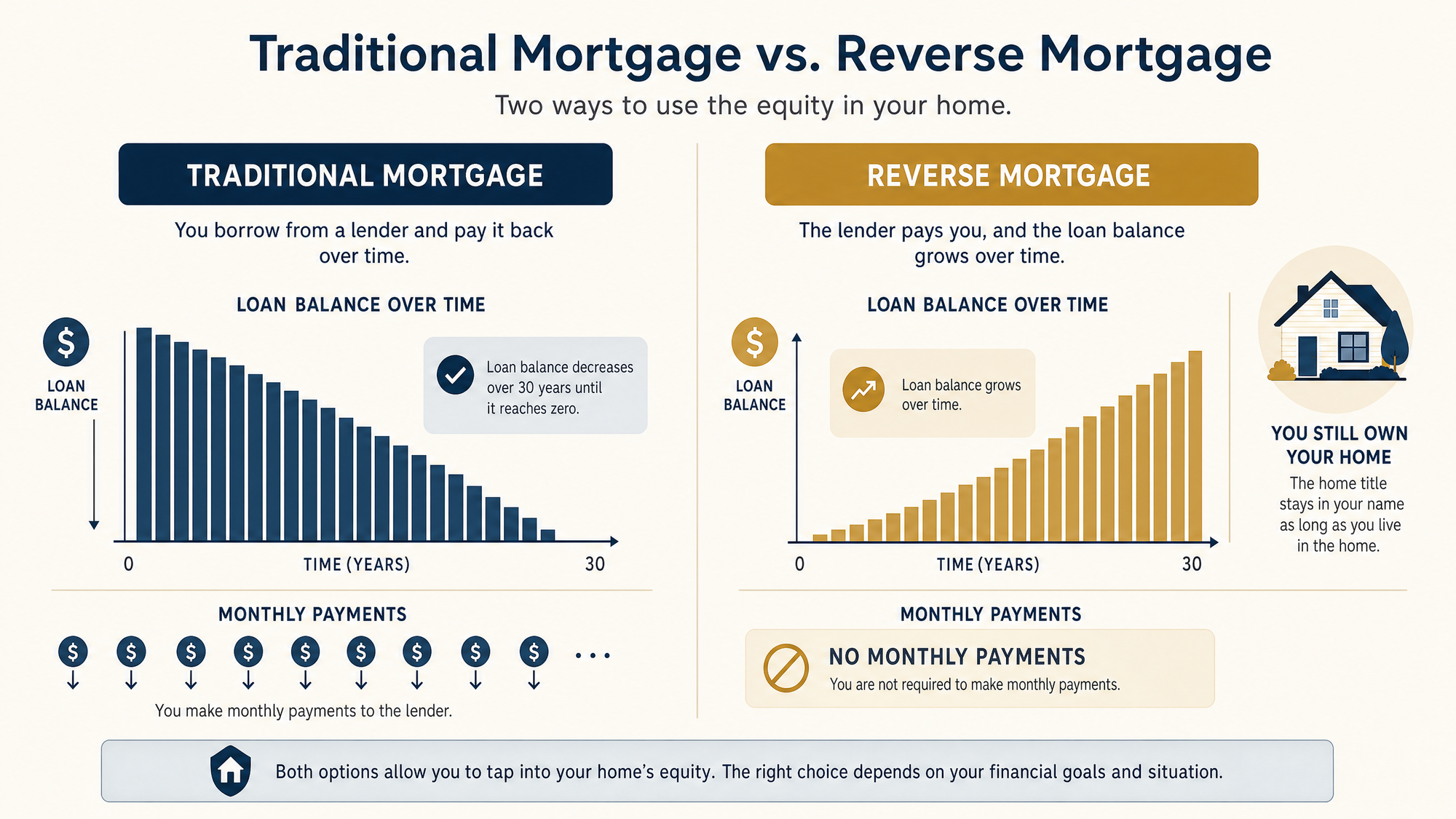
A traditional mortgage works in one direction. You borrow money, then make monthly payments that gradually reduce the principal balance over time.
A reverse mortgage turns that cash flow around.
Instead of making a required monthly principal-and-interest payment to the lender, the homeowner can access funds through a lump sum, a line of credit, or, in the case of a home purchase, financing that helps preserve liquid assets.
The central feature is straightforward: there is generally no required monthly mortgage payment as long as the borrower remains in the home and meets the loan obligations.
That does not mean the loan is free. Interest continues to accrue. Because the interest is not being paid each month, it is added to the outstanding balance. This is known as negative amortization.
So yes, the loan balance can grow over time. That is the part that makes many people immediately uncomfortable, and it should be understood before anyone considers this strategy.

Buying or Selling in Florida?
INTERVIEW MENegative Amortization Is Not the Same as a Personal Debt Trap
The concern is understandable: if interest compounds for years, could the loan balance eventually exceed the property value?
It can happen. But qualifying reverse mortgages are structured with important protections.
The homeowner keeps title to the property. The lender does not become the owner of the home. The loan is secured by a lien against the property, much like other mortgage financing.
When the borrower passes away, the home becomes part of the estate. Heirs generally have time to sell the property, pay off the loan, or otherwise resolve the balance.
For FHA-insured reverse mortgages, the loan is non-recourse. That means neither the borrower nor the heirs are personally responsible for any shortfall if the loan balance exceeds the home’s value. The lender’s recovery is limited to the home itself, subject to the program rules.
The Federal Housing Administration insurance structure is an important part of that protection. Borrowers pay mortgage insurance premiums that support an insurance pool designed to cover the lender if the property's value is insufficient to pay the entire loan balance.
For a helpful overview of the federal program and its borrower protections, review the U.S. Department of Housing and Urban Development’s reverse mortgage resources.
Keeping Cash Available Can Be a Strategic Choice
The point is not that every retiree should finance a home. The point is that an all-cash purchase is not automatically the best decision simply because it produces a paid-off house.
A reverse mortgage purchase strategy can allow an eligible buyer to put down a portion of the purchase price while retaining more cash in reserve. That retained liquidity can be used for retirement spending, unexpected costs, investments, family experiences, or simply peace of mind.
Think of it this way: owning the best survival equipment does not help much if all of it is locked inside a titanium safe you cannot open when the storm arrives.
Home equity is real wealth. But when all your wealth is embedded in the house, its utility can be limited.
The Potential Tax Timing Strategy
The most sophisticated part of this conversation is not just about cash flow. It is about tax timing.
Money received from a reverse mortgage is loan proceeds, not earned income. Borrowed funds are generally not taxable income simply because you received them.
That means an eligible homeowner may access reverse mortgage proceeds without automatically increasing taxable income in that year.
The other side of the equation involves interest. Mortgage interest may potentially be deductible when it is actually paid, subject to the tax code, itemization requirements, loan-use rules, and other limitations.
With a reverse mortgage, interest can accrue over time rather than being paid monthly. This creates the possibility of accumulated interest that may be paid voluntarily later, potentially in a year where a large deduction would be especially valuable.
Imagine someone who lets interest accrue for several years. Then, in a later year, they have a major taxable event, such as:
- Selling a business or secondary property
- Completing a substantial Roth IRA conversion
- Receiving other unusually high taxable income
In that particular year, they may choose to use available cash to pay accrued reverse mortgage interest. If the payment qualifies for a deduction, it could help offset taxable income at a strategically important time.
That is the idea: not avoiding an obligation, but controlling when a potentially valuable deduction is realized.
Tax treatment is highly personal, and this is not a do-it-yourself maneuver. The IRS rules on deductible mortgage interest are detailed and can change. Review the IRS guidance on home mortgage interest deductions and consult a qualified tax professional before making decisions based on a projected deduction.
Selling or buying in Central Florida? |
|
I'm Aleksey Volchek - agent with Kardosh Realty |
| Schedule an Interview |
Why Reverse Mortgages Earned Their Bad Reputation
It would be dishonest to pretend the industry’s reputation came from nowhere. For years, reverse mortgages were associated with genuinely troubling practices.
One of the worst problems involved married couples with significant age differences.
Because the available loan amount is based heavily on age, an older borrower can generally qualify for more proceeds than a younger one. In the past, some lenders pushed couples to remove the younger spouse from the property title so the loan could be based only on the older spouse’s age.
That created a devastating risk.
If the older spouse died, the loan could become due and payable. The younger surviving spouse, having been removed from title, might no longer have the legal ownership rights needed to remain in the home. In some cases, widows and widowers faced foreclosure and eviction after losing their spouse.
That was not a harmless technicality. It was a structural failure that caused real harm, and it is a major reason many families still approach reverse mortgages with deep suspicion.
Modern Safeguards Changed the Product
HUD and the FHA implemented major regulatory changes in 2013 and 2014 that fundamentally reshaped these protections.
Today, lenders cannot require a spouse to be removed from title simply to increase the available loan amount. A younger, non-borrowing spouse may remain on the deed.
If the borrowing spouse dies, an eligible non-borrowing spouse can generally remain in the home without having to make a monthly mortgage payment, provided they continue to meet the loan requirements, including maintaining the property and paying property taxes and homeowners insurance.
The safeguards also address the risk of accessing too much equity too early.
Reverse mortgage lending is age-sensitive. A borrower at the minimum qualifying age of 62 may need to contribute a much larger down payment because the program must account for a potentially long loan term. An older borrower may qualify to finance a larger percentage of the purchase price because the actuarial math changes.
This is not arbitrary. The structure is designed to create a cushion so that compounding interest does not immediately consume the property’s equity.
That does not make a reverse mortgage right for everyone. It does mean the modern product is far more regulated and protective than the version that earned the industry’s worst reputation.
A Different Way to Think About Legacy
The real conversation is bigger than financing. It is about what you want your wealth to do for you and your family.
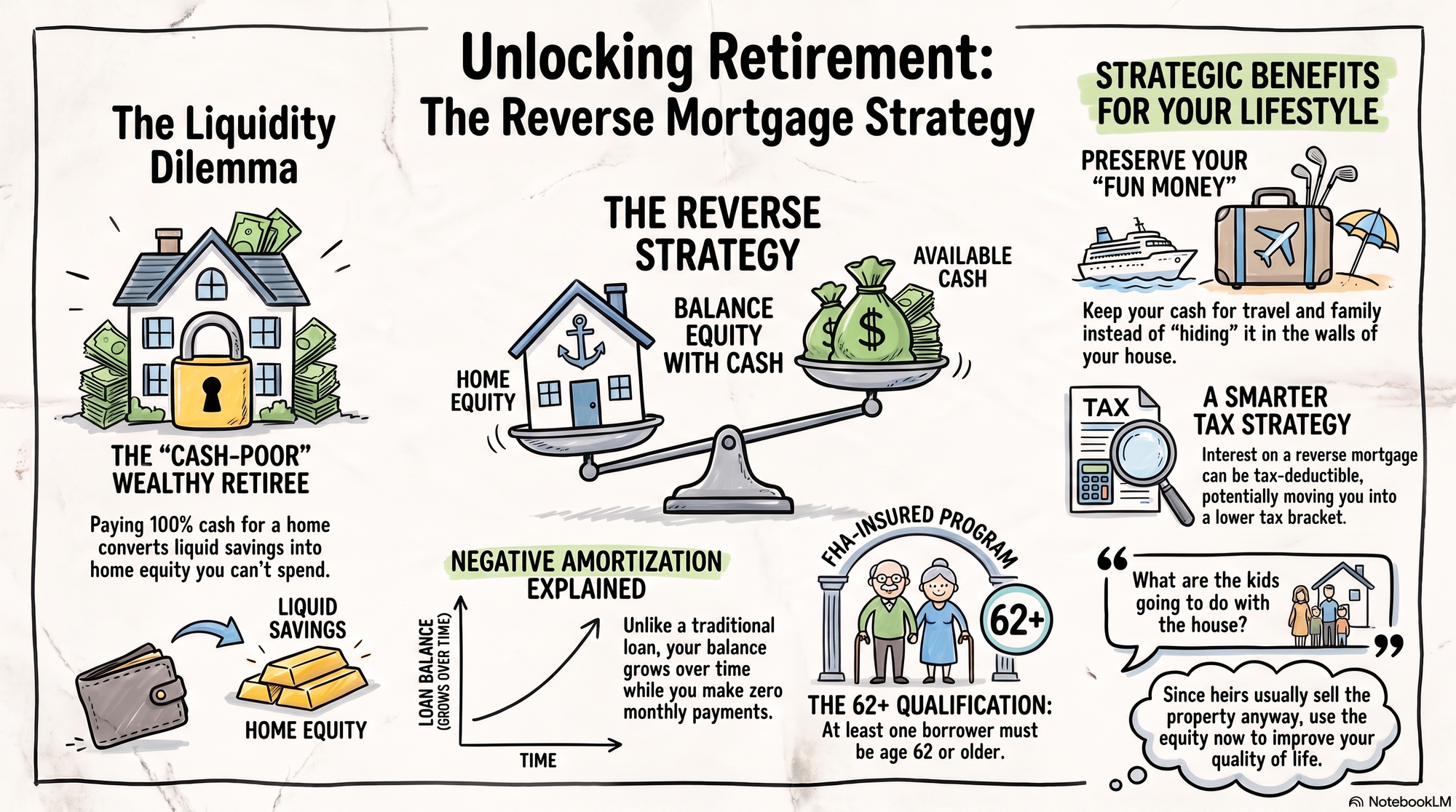
Many retirees live with unnecessary scarcity because they are focused on leaving behind the largest possible paid-off house. They cut back on travel, avoid experiences, stress over expenses, and protect every dollar of liquidity for an inheritance.
Then, when the children inherit the home, they may sell it immediately. They have careers, communities, school districts, and lives somewhere else. The home becomes a transaction, and the inheritance becomes a wire transfer.
That does not mean leaving an inheritance is wrong. It means the goal deserves an honest conversation.
Would you rather leave a somewhat larger inheritance later, or use some of the wealth today to create time, security, and memories with the people you love?
A properly structured reverse mortgage may offer one way to balance both goals. It can preserve cash flow, provide access to equity, protect heirs from personal liability under the non-recourse framework, and potentially support thoughtful tax planning.
Moving to Florida? Evaluate the Whole Balance Sheet
If you are relocating to Central Florida for retirement, do not make the decision based only on whether you can pay cash for a home.
Look at the full picture:
- How much cash will remain after closing?
- How much liquidity do you want for healthcare, travel, family, and emergencies?
- What are your property tax, insurance, maintenance, and HOA obligations?
- What does your estate plan prioritize: maximum transferred wealth, present-day lifestyle, or both?
- Would a traditional mortgage, a reverse mortgage purchase, or an all-cash purchase best fit your goals?
For those considering a newly built home, it is also important to understand how builder incentives, rate buydowns, deposits, and contract terms can affect the overall transaction. Read more about how to negotiate new construction deals and builder incentives in Orlando.
The old late-night commercial stereotype is too simple. A reverse mortgage is not automatically a scam, and it is not automatically a solution. It is a financial tool with costs, rules, risks, and potential advantages.
The better question is this: is your hard-earned wealth locked away where it cannot help you, or is it liquid, intentional, and working to support the life you want to live?
Before making a retirement housing decision, speak with qualified mortgage, financial, tax, and legal professionals who can evaluate your personal circumstances.

About The Expert
Peter Kilsheimer
Evergreen Home Loans | (407) 702-9277
Disclaimer
This article is intended for educational purposes only and should not be considered mortgage, tax, legal, or financial advice. Reverse mortgages, retirement planning strategies, and estate planning decisions are highly individual and may not be appropriate for everyone. Homeowners should consult qualified mortgage professionals, financial advisors, tax professionals, and attorneys before making decisions involving reverse mortgages or retirement planning.