


Photo by Towfiqu barbhuiya on Unsplash
Aleksey Volchek - Bear Team Real Estate
Through articles like this I share market insights, thoughts, and opinions - anything that can impact your selling or buying strategies.
Interview me to help you buy or sell real estate in OrlandoOrlando Real Estate is not one simple market moving in a single direction. Mortgage rates, builder incentives, cash buyers, existing homeowners with low-rate loans, and changing inventory levels can create very different conditions from one neighborhood, property type, and price range to the next.
A buyer comparing new construction in a growing Central Florida community may have more negotiating leverage than a buyer seeking a move-in-ready resale home in an established neighborhood. A seller may see strong interest in one location while a similar property elsewhere faces direct competition from new homes and incentives.
The most useful way to evaluate Orlando Real Estate is to replace broad headlines with a property-specific strategy. Start with the buyer or seller position, compare the relevant competition, and understand how financing and inventory shape the negotiation.

Table of Contents
- Why Orlando Real Estate Does Not Move as One Market
- How Higher Mortgage Rates Affect Orlando Buyers
- New Construction Is a Major Competitive Factor
- Inventory Is Useful Only When It Is Local and Current
- Are Orlando Home Prices Rising or Falling?
- A Better Decision Process for Orlando Buyers
- A Better Decision Process for Orlando Sellers
- Common Orlando Real Estate Mistakes to Avoid
- What to Monitor Before Making a Move
- The Bottom Line
Why Orlando Real Estate Does Not Move as One Market
National housing headlines often imply that every homebuyer and homeowner faces identical conditions. In practice, Orlando Real Estate contains multiple markets operating at once. The participant with the most favorable terms, inventory, or financing may have a very different experience from someone on the other side of the market.
A practical framework separates today’s housing market into four major groups:
- Cash buyers: Buyers who do not need mortgage approval can often move faster and avoid interest-rate exposure.
- Financed buyers: Buyers using a mortgage must qualify based on current rates, loan terms, down payment, income, and credit.
- Existing homeowners with low mortgage rates: Owners with substantially lower rates may hesitate to sell because purchasing another home could mean taking on much more expensive financing.
- Builders: New-home builders need to sell completed and upcoming inventory, which can lead to financing incentives, closing-cost contributions, upgrades, or price flexibility.
These groups do not compete on equal terms. That is why a single statistic about national prices or mortgage applications should never be used as a complete answer for an Orlando Real Estate decision.
How Higher Mortgage Rates Affect Orlando Buyers
Higher mortgage rates affect affordability, but they do not stop all activity. The impact depends on how much financing a buyer needs, the rate available to that borrower, and whether a seller or builder is contributing toward costs.
It is also important to distinguish the Federal Reserve’s policy rate from the rate on a 30-year mortgage. The federal funds rate is an overnight benchmark. Mortgage rates are influenced more directly by longer-term bond market conditions, including the 10-year Treasury yield and the spread between Treasury yields and mortgage rates. The Federal Open Market Committee affects the broader rate environment, but a Federal Reserve decision does not automatically create an identical mortgage-rate change.
For Orlando Real Estate buyers, the practical takeaway is simple: avoid making a plan based on an assumed future rate cut. Qualify and evaluate a purchase using the payment, cash-to-close amount, and loan terms available now. If rates improve later, refinancing may be an option, but it should not be the only reason a purchase works.
Use the full monthly housing cost
A monthly payment is more than principal and interest. Before making an offer, account for:
- Mortgage principal and interest
- Property taxes
- Homeowners insurance
- Mortgage insurance when applicable
- HOA or condo association dues
- Special assessments or community fees when applicable
- Maintenance, utilities, and reserves for repairs
Buyers should compare these figures between homes rather than focusing only on list price. A less expensive property with high fees or insurance costs can be less affordable than a higher-priced alternative with lower recurring expenses.
For a fuller review of financing paths, down payment choices, and common lending errors, consult this Orlando home buying guide.
New Construction Is a Major Competitive Factor
In Orlando Real Estate, new construction can materially change resale market conditions. Builders commonly have a different economic position from individual homeowners. They may have completed homes to move, construction financing, planned future releases, and an incentive to maintain a sales pace.
That does not mean every new home is automatically the best value. It means buyers should compare a new build and a resale home using the same complete-cost framework.
Why buyers may be drawn to new homes
New construction can appeal because it may offer a newer design, modern features, warranty coverage, and builder-supported financing options. In certain markets, the incentives attached to a new home can improve affordability more than a small reduction in resale list price.
However, incentives should be read carefully. A financing incentive is not the same as a lower purchase price, and an upgrade package is not the same as a closing-cost credit. Buyers should ask for each option in writing and calculate the total impact over the expected ownership period.
Why resale sellers must pay attention
A resale seller competing with nearby new builds cannot simply rely on a prior neighborhood sale. The buyer may be comparing that resale property against a builder offering rate support, closing-cost assistance, upgrades, or a newer floor plan.
For Orlando Real Estate sellers near active development, the relevant competition includes:
- Comparable resale listings
- Builder base prices
- Advertised incentives
- Quick move-in inventory
- Lot premiums and upgrade costs
- Estimated delivery timing
- Monthly HOA and community charges
A seller who ignores these alternatives can overprice the home, wait too long for activity, and eventually make a larger price adjustment than necessary. Sellers should instead position the property around its real advantages, such as location, lot size, landscaping, established amenities, completed improvements, or a faster closing timeline.
Buyers considering a builder purchase can review practical negotiation points in this guide to negotiating new construction incentives and contract terms.
Inventory Is Useful Only When It Is Local and Current
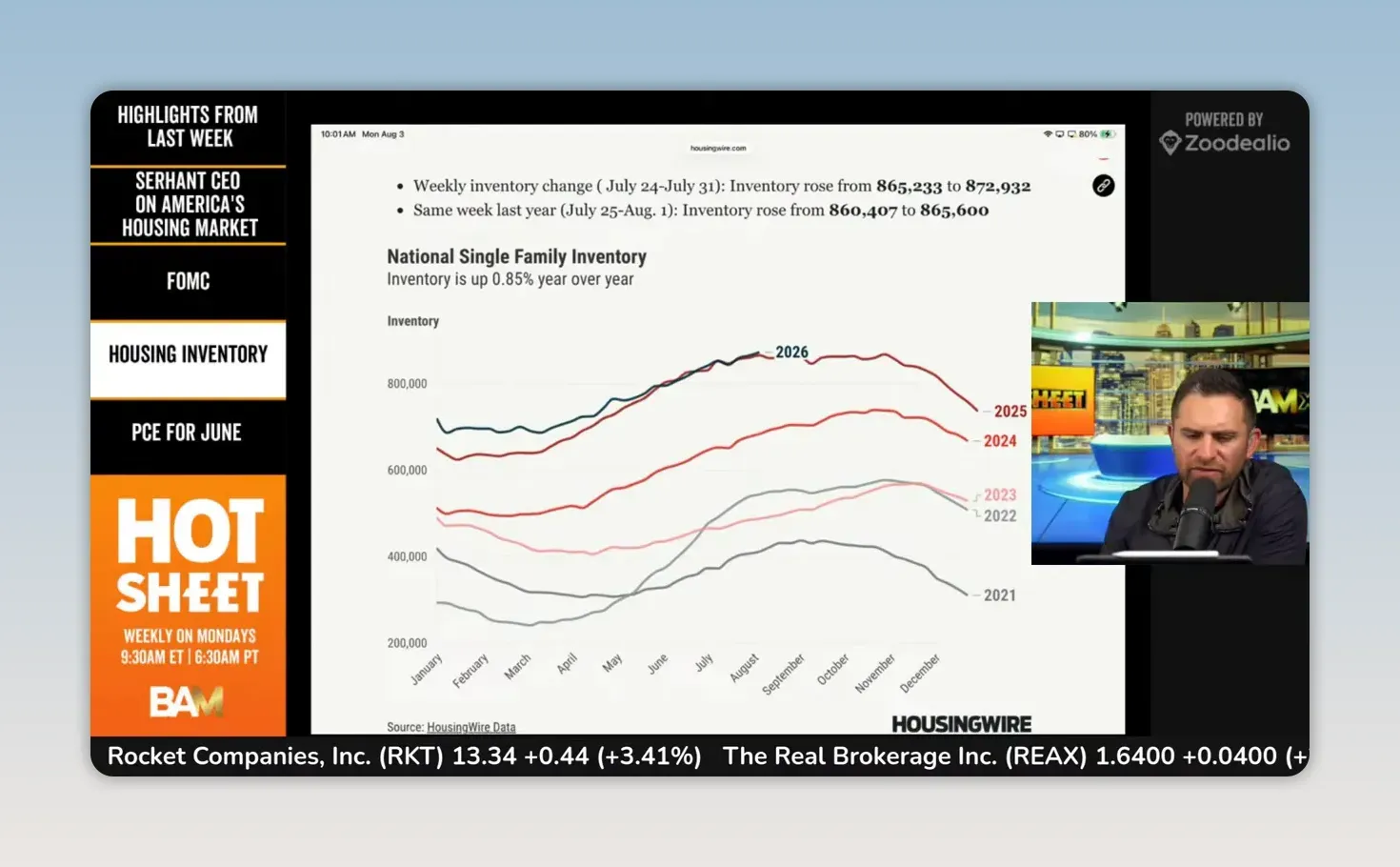
Inventory is one of the most important Orlando Real Estate metrics, but it must be interpreted at the right level. National single-family active inventory was broadly flat with the prior year in the referenced market data, while new listings were already past their seasonal peak. That can offer context, but it cannot tell a homeowner whether a particular Orlando neighborhood has too few homes, too many competing listings, or substantial builder supply.
Instead, narrow the analysis to the actual property category. A strong local comparison should include homes that match the subject property as closely as possible by:
- Neighborhood or immediate area
- Property type, such as single-family, townhome, or condo
- Price range
- Bedroom and bathroom count
- Square footage and lot characteristics
- Condition, age, and upgrades
- School zone or commute patterns when relevant
- Whether the property is new construction or resale
In a segmented Orlando Real Estate market, one price band can be competitive while another has lingering listings and frequent reductions. Local supply determines the strategy, not a national headline.
Are Orlando Home Prices Rising or Falling?
The right answer is usually more nuanced than “up” or “down.” Broad measures can show nominal price gains while inflation reduces the real purchasing power of those gains. In other words, a home price can increase modestly on paper while still failing to outpace inflation.
For buyers and sellers, nominal versus real price growth is informative but secondary to the decision at hand. A homeowner needs to know what comparable properties are accepting today. A buyer needs to know whether the monthly payment is sustainable and whether competing homes offer better value.
Orlando Real Estate pricing should be judged by recent closed sales, active competition, pending activity, days on market, concessions, and price reductions. List prices alone are not proof of value. Neither is a single past sale from a markedly different rate environment.
Price cuts are information, not automatic failure
A price reduction can mean a listing began above the market, the home has a condition or location challenge, the seller needs a quicker closing, or competition has changed. It does not automatically indicate that all homes in the area are declining.
Buyers should study why a property has been reduced before treating it as a bargain. Sellers should review reductions on comparable homes to learn where buyers are resisting, then set a price and marketing plan that responds early rather than late.
A Better Decision Process for Orlando Buyers
Buying Orlando Real Estate in a higher-rate environment requires preparation and flexibility. The goal is not to predict every economic release. The goal is to make an informed offer on a home that fits the household’s needs and budget.
- Confirm financing first. Obtain a meaningful preapproval and understand the payment range, cash needed at closing, and possible loan programs.
- Set a payment ceiling. Choose a monthly cost that works without relying on future refinancing or uncertain income changes.
- Compare resale and new construction. Calculate total cost, incentives, delivery timeline, HOA fees, upgrades, and estimated future expenses.
- Study the immediate competition. Review active, pending, and closed homes that a seller will actually use as alternatives.
- Make the offer structure match the property. A home with multiple interested buyers may require stronger terms. A stale listing or builder quick move-in may support a more negotiated approach.
- Keep inspection and contract protections appropriate. A lower price is not a win if the buyer accepts avoidable property, financing, or contract risk.
Cash buyers may have a speed advantage, but financed buyers can still compete effectively with strong underwriting, a realistic timeline, and clear contract terms. Orlando Real Estate decisions should be based on the buyer’s actual leverage, not an assumption that every purchase requires an all-cash offer.
A Better Decision Process for Orlando Sellers
Sellers need to recognize that many buyers are highly payment-sensitive. The best Orlando Real Estate listing strategy is a combination of correct pricing, compelling presentation, and an honest assessment of alternatives.
- Start with the current market, not a peak-era expectation. Use recent comparable sales and active alternatives rather than relying on an aspirational number.
- Audit nearby builder competition. Identify incentives and available inventory if new communities are relevant to your buyer pool.
- Prepare the home before launch. Condition, photography, staging, repairs, and pricing work together to create early momentum.
- Price for comparison. Buyers filter listings by price brackets. A home should make sense beside the alternatives that appear in its search range.
- Evaluate feedback quickly. Repeated objections about price, condition, layout, or location indicate that a response may be needed.
- Consider net proceeds, not only headline price. A stronger contract can be worth more than a higher offer with weak financing, excessive contingencies, or uncertain timing.
The biggest seller mistake is assuming a home will sell because the market moved quickly several years ago. The current Orlando Real Estate environment rewards precision. Buyers can compare more options, and sellers must provide a clear reason to choose their home.
Common Orlando Real Estate Mistakes to Avoid
Waiting for the perfect interest rate
Waiting can be reasonable when a purchase is not financially ready. But waiting solely because a future rate is expected can be risky. Rates can remain elevated, inventory can change, and a better rate may bring more buyer competition. Focus on affordability now and the ability to keep the property through normal market changes.
Assuming builder incentives are free money
Builder offers deserve close review. Compare the rate, loan costs, price, upgrades, terms, and alternatives from independent lenders. The best deal is the one that produces the best overall outcome for the buyer, not necessarily the largest advertised incentive.
Using national news as neighborhood-level advice
National pending sales, inflation reports, and mortgage application data provide useful background. They do not replace an Orlando Real Estate analysis built around the actual home, neighborhood, and competition.
Confusing price appreciation with affordability
A home can be appreciating while becoming harder to buy because borrowing costs have risen. Conversely, a buyer may find opportunity in a flat price environment if the seller or builder can offer favorable terms. Price and payment must be evaluated together.
What to Monitor Before Making a Move
Economic releases can influence sentiment and mortgage markets, particularly inflation data, employment reports, consumer expectations, Treasury yields, and Federal Reserve policy decisions. Still, those indicators should serve as context, not as a reason to rush into or out of Orlando Real Estate.
Buyers and sellers should monitor a short local dashboard:
- New listings and active listings in the target area
- Pending and closed sales of relevant comparable homes
- Days on market and price-reduction patterns
- Builder inventory and advertised incentives
- Current mortgage options and lender quotes
- Estimated net proceeds or cash-to-close figures
This approach turns a confusing market into a manageable decision. The market is still functioning, but the advantages are uneven. The right strategy depends on which side of the transaction you occupy and what alternatives are available.
The Bottom Line
Orlando Real Estate is best understood as a collection of connected but different markets. Cash buyers, financed buyers, low-rate homeowners, and builders all have different motivations and negotiating power. That is especially important where resale homes and new construction compete for the same buyer.
For buyers, the priority is a sustainable all-in payment and a complete comparison of homes and incentives. For sellers, the priority is realistic positioning against current resale and builder competition. A local, data-driven plan is more valuable than trying to make a decision from a national housing headline.
For help evaluating a purchase, sale, or local competitive analysis, explore available Central Florida real estate services.
Orlando Real Estate FAQ
Is Orlando Real Estate a buyer’s market or a seller’s market?
It depends on the neighborhood, price range, property condition, and whether new construction is competing for the same buyers. Some properties can attract strong demand while others need price reductions or concessions to sell.
Do Federal Reserve rate decisions directly set Orlando mortgage rates?
No. Federal Reserve policy influences the broader financial environment, but mortgage rates are driven more directly by longer-term market factors, including Treasury yields and mortgage-backed securities conditions.
Should buyers choose new construction over a resale home in Orlando?
Neither option is automatically better. Compare the complete cost, including price, financing, builder incentives, upgrades, HOA fees, timeline, location, and condition. A resale home may offer an established location or completed improvements, while a builder may offer incentives or newer features.
Can Orlando sellers compete with builder incentives?
Yes. Sellers can compete through accurate pricing, strong preparation, a clear value proposition, flexible terms where appropriate, and by highlighting advantages a new build may not offer. The first step is understanding exactly what nearby builders are offering.